Clearing a Parent's House After They Pass: What to Set Aside Before the Crew Arrives
The sorting that only family can do should happen first, and a little structure makes it far less painful.
October 17, 2026 · 4 min read
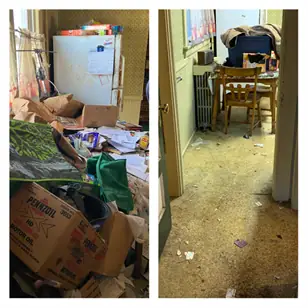
Walking into a parent's house after they have died is hard in a way no checklist can fix. The rooms still feel like them. The mail keeps coming. And somewhere in the back of your mind is the knowledge that the house has to be dealt with, usually sooner than anyone feels ready for. We are Mess Haul Men, and estate clean-outs are a big part of our work around Killingworth and Middlesex County. This article is about the part that belongs to the family, the sorting that should happen before any crew shows up with a truck.
Start with paper, not furniture
The things people regret losing in a clean-out are rarely the big ones. They are small and flat: an envelope in a kitchen drawer, a folder at the bottom of a desk, a checkbook in a coat pocket. Before a single piece of furniture moves, go through the places where people keep paper. Desk drawers, filing cabinets, nightstands, the junk drawer, bookshelves, the inside of cookbooks, the pockets of coats in the hall closet. People tuck important things in ordinary places, and they rarely tell anyone where.
- Deeds, titles, and anything that looks like a legal or financial record
- Tax returns and statements from banks, insurers and retirement accounts
- Birth, marriage, military and other certificates
- Address books, calendars, and passwords written on scraps of paper
- Keys, including the ones nobody can identify
- Cash, checks, savings bonds and unopened mail
Put all of it into one box or bin and decide who carries it home. Do not sort it on the spot, and do not throw any of it out yet. We are a clean-out company, not lawyers, so questions about what the estate needs to keep, and for how long, belong with the estate's attorney or the probate court. Ask them before anything gets shredded.
Photographs and the things with stories
Photographs are the hardest category, because there is never just one box. There are albums, shoeboxes, slide trays, framed pictures on the stairway wall, and loose prints in drawers. Gather them into one place before you do anything else. You do not have to sort them in the house. Move them to a table, a spare room, or your car, and look at them when you have the energy. Scanning can wait for months. Getting them out of a damp basement or hot attic cannot.
Keepsakes work the same way. Jewelry, medals, letters, recipe cards in handwriting, a tool with a name scratched into the handle, the coat that still holds a certain smell. Set them aside as you find them, and look inside things as you go: coffee tins, sewing boxes, books, the toes of boots. A crew moving fast through a house will not know which ordinary-looking tin holds a family ring.
The maybe pile needs a boundary
Every family ends up with a maybe pile. It is a healthy instinct, because grief makes it hard to say no to anything. The risk is that the maybe pile grows until it is the whole house again. The fix is to give it walls.
- Pick one room, or one corner of the garage, as the maybe room. Nothing outside it counts as maybe.
- Give each family member the same number of boxes, or the same colour of painter's tape, so claims stay fair.
- Set a date and tell everyone what it is. Pick it before you start, not after.
- Take a photo of anything that is hard to part with but impractical to keep.
- Whatever is still in the maybe room on the date goes into the clean-out, no exceptions.
The date is the part that works. It turns an endless decision into a finite one.
When the family is spread across states
Often the person closest to the house does nearly all the work while everyone else is a flight away. A few habits keep that from turning into resentment. First, do a video walkthrough of every room so everyone sees what is there at the same time. Second, put photos into a shared folder, one folder per room. Third, ask everyone to send a short list of what they want by a set date. Five items each is plenty to start with. Fourth, agree in advance on who breaks ties.
Decide what will actually be shipped, and by whom, before anyone says yes to a piece of furniture. A dresser someone wants in theory becomes a real problem once it has to cross state lines, so let each person arrange their own piece.
Handing over the rest of the house
Once the paper, photographs and keepsakes are out, and the maybe pile has had its deadline, what is left is a clearing job. That is the part we do. Walk the house once more and mark anything that stays, whether it is for a sale, for a relative moving in, or for one more weekend of sorting. Painter's tape with a name on it works well. Tell us what is staying, and we will clear around it.
If you are not local, you do not have to be in the house for us to start the conversation. Text photos of each room to 860-227-3403 and tell us what you are working with. If you have questions about how a particular item will be handled, ask Steve Quilliam when you reach out. Call or text 860-227-3403, or email messhaulmen@gmail.com, and we will give you an initial quote based on the house and the timeline you have.
Mess Haul Men, LLC, 860-227-3403
Call 860-227-3403More articles
The Garage You Can't Park In: A Weekend Plan Before You Call for Junk Removal
Most garages are not full of junk. They are full of undecided things, and a weekend is enough to decide.
Basement and Attic Clean-Outs in Older Connecticut Houses: What's Down There and What Stays
Older houses hold generations of belongings, and a clear sense of what stays makes the clean-out safer and quicker.